The porthole of the coin-operated washing machine, spinning.
The hum of the machines, the still-fluorescent lights, and the smell fill both the space and the waiting time. Thirty minutes that feel like an eternity, between cigarettes smoked and mindless scrolling through news, peeping at profiles, and completing yet another sudoku — beginner mode, obviously, because let’s be honest, everyone likes to win, and doing it without too much effort makes everything nicer in its simplicity.
The notification, the banner, the tap to open the regular — like death — notification: “One year ago today,” Google serving up memories you may not be all that eager to revisit.
You tap, you wait, it opens and slaps you with the photograph. Always the same one. Always the same angle, the same framing of the water meter.
That thing — yes, thing, because what would you call it?
A tool?
An apparatus?
A device?
A thing shaped like a bulbous appendage of the pipe that brings water from outside into your home, to all your taps, with its little numbered dials and tiny (utterly pointless) needle gauges telling you — informing you — exactly how much water, in rigorous and precise cubic metres, you have consumed.
The same photo. Of the same object.
Placed in a spot so awkward and unreachable that over the years I’ve perfected an infallible technique for reading those numbers and writing them on the Post-it that I regularly, every single time, stick to the front door so the meter reader can note it down on his form and send me, shortly thereafter, the bill in the form of a postal payment slip.
The technique is simple: I turn off the flash (which would otherwise blind the whole image off the glass, making it impossible to read those notorious faded numbers), I lean the edge of my smartphone against the nearby pipe, and with my thumb I press the button and wait those few seconds for the camera to do its job — reconstruct a sharp image out of the surrounding darkness and present it to me, clean and precise, so I can write down the number I need (specifically, for the sake of accuracy, 6065, the last one transcribed).
Every time, without fail, I fall for it.
I take this photo, useful for one purpose only — immediate and momentary — and it stays there in the gallery. And every time, without fail, it triggers that notification. Always the same, always monotonous.
I don’t delete it. Maybe out of haste (it’s a gesture I perform ten minutes before leaving the house on reading day), maybe out of the habit of shooting, taking, and tucking away, into that memory and gallery that seems to never run out of space.
Looking at this same photo each time — tricked by the compulsion to read that alert with the ding that accompanies it — I’ve felt, I’d say, strange, processing the fact that this always-identical photograph, always the same subject, always the same framing (and let’s say the same colour grading and exposure too), was always identical, always the same, and yet always different.
Unique.
The uniqueness lay precisely in those numbers, which had never been the same twice — and which, in a lifetime lived (mine or the meter’s, little difference), I would almost certainly never see repeated.
Every time I looked at that photograph, those details were and had been different. Just as the date accompanying the notified memory was different. Time made the difference. The moment, the exact state of that object at that precise instant, made that image that one and that one alone.
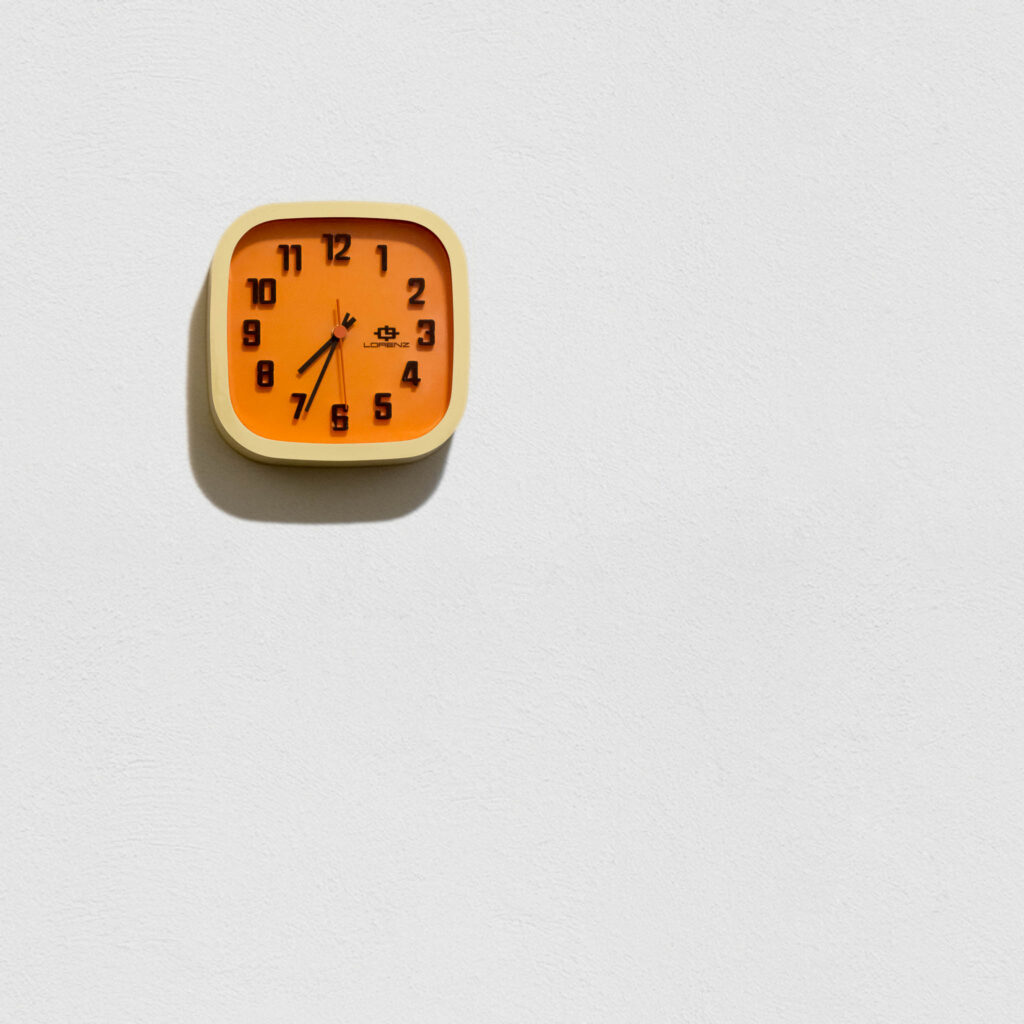
It’s not like a clock — one of those old analogue ones with hands.
It’s not like photographing one of those at a precise moment.
Every day, always, every week, month, and year, at least twice, it deludes you into thinking it represents that exact instant — even though in reality it doesn’t.
I found myself looking around the laundromat, at the walls with their white and blue metro tiles. I watched the portholes of the washers and dryers spinning. Always the same motion, relentless and enduring. Always tracing the same path through space, giving you the sensation of an inescapable repetitiveness — and yet changed, and every time different, because of their contents, which had never been and would never be in the same position and arrangement.
Back to the meter and its digital representation, archived on my device and scattered in bits across God knows what other corner of the globe.
Unconsciously, yet with an almost maniacal regularity of the system (and let’s be honest, of the reader who comes to take the readings too), seeing that always-same, always-different image for months and years — I think it’s led me to think.
Not a logical, linear, rational thought: something more like a doubt that erodes certainties, subtle and silent, like the embers that linger after a fire.
I must have walked past it waving a rag soaked in petrol dangling from a bottle.
Maybe.
I wouldn’t know.
Or I simply don’t remember, or didn’t notice.